I’ve got
some less of 2 months left in South Africa, something that at the beginning of
this African year sounded a lot and now I know is not even a blink. Only 6 more
weeks on the project and hopefully 2 weeks crossing the country. After, who
knows. I’ve just withdrawn my application for a PhD in which I was going to
work with chimpanzees because I couldn’t find a scholarship and I have nothing
prepared yet for next year. My country is falling into pieces and, if it was
difficult to find a job before the crisis now seems a miracle. No that I wanted
to stay there anyway, but I’m pretty lost right now. But well…if something I’ve
learn too is that even if 2 months are short, a single day can change
everything, so let’s keep hope. So, while trapping, tagging and following
monkeys, I’ll be working on CVs and application to see if I can continue my
biological adventures and I don’t end up as many others. Hope, keep on
standing,
Monday, August 27, 2012

Friday, August 24, 2012
Interspecific mohawks
As I said before, this month I am helping with camera-trapping; nice task that consists on walking several kilometres a day collecting the cards of the camera traps, changing batteries and then coming back to the Barn to tag the pictures and ID the leopards; helping to construct the home ranges of these last and to assess the biodiversity of the area and its activity patterns, among others.
While tagging I could not stop noticing a marked trend among the animals, unrelated to the species...there are many punks around the mountain! Just see it by yourself


While tagging I could not stop noticing a marked trend among the animals, unrelated to the species...there are many punks around the mountain! Just see it by yourself
 |
| Common Warthog (Phacochoerus africanus) |
 |
| Crested Guineafowl (Guttera pucherani) |
 |
| Brown hyena ( Hyaena brunnea) |
 | |||||||||||||||||||||||||||||||||||||||||||||||||||||||||||||||||||||||||||||||||
| African civet (Civettictis civetta) |
And the kings by excellences of mohawks, the porcupines (Hystrix africaeaustralis)


Samango kingdom hit by Belgian Earthquake; blue sky as aftermath
Two weeks
ago, a new volunteer arrived to work with the samangos, the Belgian. After some
research in primates as a part of her studies, she has been working in
conservation for several years and decided to take a short break in her job to
come back to the forest and crawling on the ground pursing elusive monkeys.
As a
primate co-ordinator (sounds great, but only means that I have to spend lots of
hours trying to disentangle and homogenize the mess of data we have and prepare
the PDA and so on, not that I know much, unfortunately, though I do my best); I
had to train her. So, on Tuesday 6:30, we started the training, just in
front of the Barn, where the monkeys had been kind enough to appear. In a
matter of minutes, she realized of all the pitfalls that the data collection.
While the monkeys travelled slowly (very kind of them) towards Bush camp, I was
telling her all the story of the primate side of the project since I arrived
and my pretty useless struggle to improve the methods, gaining only a lot of
stress, social marginalization and even some white hairs! By the second day,
she was the one teaching to me about the monkeys. She not only realized of the
different between sub-adults and juveniles, age-classes that I joined because
there was a lot of disagreement between my old fellows, but was able to
distinguish between male and female sub-adults by looking at the teeth,
something that I hadn’t think about.
At first I
was quite ashamed that she knew more than me, and felt sympathy for the
Cardiffian, who probably went through something similar when I arrived but, in
contrast to her, I felt, finally, relief.

Finally there was someone in the project that
could teach me something about the monkeys and that agreed with me that we
needed to improve the methodology (well, best of all, establish and objective
for the data collection!!!). So , in some days, when the director arrives, we
will have a meeting with him to try to make of this a serious project. But,
even if nothing changes before I leave, it was quite good to see the Belgian
crawling on the ground to pass a fence determined to don’t miss a single scan
of the monkeys…while some of my fellows could loose one hour of data just
because they couldn’t find a hole on the fence to pass. Finally, a real
primatologist in the project, I missed to see someone dedicated so much after
all the sloth that I had seen, suffering under the absurd dictatorship of
undergraduate students with too much power and little knowledge… Summarizing, I
am really glad and hopeful, maybe my time in South Africa is not doing to be a waste of time
after all.
In
addition, most of the people that were here before have left, and only the
Belgian, The French-Spanish and me remain as volunteers of the project, so the
average age and experience has increased dramatically and it finally seems that
we are carrying out a research project and no a g&%dam summer camp.
Anyway; I
am still with the camera-traps and so I will at least 2 weeks more, that I’ll
have to come back with the monkeys because two new volunteers are arriving for
working in the predator side. Until then, I will enjoy my walks with the
French-Spanish up and down Lajuma and the surrounding properties checking
cameras and tagging them after, finding surprises like crazy juvenile baboons
shaking the camera on a daily basis or watching the battle between to
porcupines. Additionally, the leopard trapping is re-starting in a couple of
days and some people has come to tag some samangos to take samples for genetic
analysis among other things, and the Frenchs are leaving and slowly being
replaced by Germans (Prefer the formers, I was improving my understanding of
French quite a lot, but c’est la vie). So, let see if the last month and a half
that I’ve got here is, FINALLY, something worthy to tell, full of biology and
only patched by social problems. Now the sky is bluer, the slopes less tiring and even the bushbabies sound like music.
Friday, August 17, 2012
Steping into camera-trapping
 |
| Bonnie, one of the leopards, punching the camera-traps ("arg, one cannot get rid of paparazzis not even in the thicket" she commented indignant) |
Afte three months following the samango monkeys through their thorny and thick
kingdom, my time came to switch to the predator side of the Project (although
I’m still responsible of handling the mess of data we have of the monkeys).
Last
Saturday, finally, I could experience the nice life of camera-trapping. The
introduction was pretty good, going to check the traps of the mythical
Sigurwana. I went at 7 to Bush camp to meet the French-Spanish and then we
start to walk. To my horror, we had to climb the leopard trail through the
chimney (It’s not that hard and I do it many afternoons just to do something,
but the me in morning and the me in the evening are different people). After
that, we followed to the Mount Lajuma and climbed until the settle,
crossing the border of Lajuma and getting into the lands of Sigurwana.
After some
slips, thanks to the killer-grass (don’t know the real name, but this is
appropriate enough), and ups and downs through some hills we finally reach a
sand road where we had to wait for the ranger. We were pretty co-ordinated and
the man was there 30s after we arrived. He was a chatty middle-age man that, as
the Afrikaner, was like a encyclopaedia of South African wildlife and
conservation. He drove us to the different cameras while chatting about his
plans to transform the little reserve into a research centre and teaching us
things such as tell apart the footprints of a leopard and a brown hyena.
After
collecting all the cards of the camera traps he took us to the fancy camping of
the reserve, so we could copy the pictures into their computers, while having
some coffee and cookies. The place was actually pretty awesome, the typical
“safari” camping of the magazines.
 Another
day, we went to check cameras on the properties at the East of Lajuma; which
was an 8-hours walk, including a short visit to a cave with paintings of the
ancient inhabitants of the mountains, the Khoi San.
Another
day, we went to check cameras on the properties at the East of Lajuma; which
was an 8-hours walk, including a short visit to a cave with paintings of the
ancient inhabitants of the mountains, the Khoi San.
We also had
to check one which was after climbing up and down a mountain and close to some
more paintings and the cameras of the properties at the West of Lajuma; though
that day we had to take the car because they are fairly apart from one another.
Back at the
Barn, the processing of pictures starts which is, pretty much go one by one
tagging the animals which appear on them. When the camera has taken around 500
pictures everything is alright, but when you find 4000 is kind of exhausting.
Baboons love to hang around the cameras and they usually are in a quarter of
them. Sometimes crested Guinean fowl and cows; but sometimes you get nice surprises,
such as the tail of a Greater Bushbay, a caracal or a serval looking directly
into the camera o a brown hyena with a kind of punk hairstyle. When we find
that a leopard came around, we had to find out who is she or he by looking at
the spots. Sometimes is easy, if the leopard has been seen before it that
station; if not, you can be an hour swimming in a sea of spots and end up with
a great headache; but is rewarding when you can finally give a name to the
spotty cat on the picture.
Here are
some examples of the images that we are lucky to see (and before you wonder,
yeah, I’m allowed to use the images as long as I don’t show the information
attached to them):
 |
| Bonnie, one of the leopards (Panther pardus) |
 |
| Common duiker ( Sylvicapra grimmia) |
 |
| Bushpig (Potamochoerus larvatu) |
 |
| African civet (Civettictis civetta) |
 |
| Slender Mongoose (Galerella sanguinea) |
 |
| Honey Badger (Mellivora capensis) |
 |
| Chacma baboons (Papio ursinus) |
 |
| Brown hyena ( Hyaena brunnea) |
 |
| Common Warthog (Phacochoerus africanus) |
 |
| Bushbuck (ragelaphus sylvaticus) |
Thursday, August 2, 2012
REVIVAL: The curse of the master thesis. Episode II
(Go here for Episode I)
The next
days I was going to the Serveis to measure the standard substances. I liked the
Serveis because they were the most similar thing I had seen so far that was
close to the precision and seriousness that my Physics teacher of the high
school (aka La pellejo ( The skin; kind of female version of Mr.Barns of the
Simpsons) had traumatized me to expect...even if I wondered why I had to be so
careful with the methanol when doing the lipid extraction, but I could use it
so happily in the Serveis to clean all the stuff... some of the many things
that didn't make sense at all...
The best
pattern to measure was the CH7, with was a kind of bloody plastic that stuck on
every single thing it touched, so I needed one hour per beaker...Anyway, I
tried to find it the positive point and I saw my long hours measuring as a Zen
exercise.
It was the
middle of December when one day I met the Great Portuguese along the corridors
of the department and asked me if our supervisor had already looked up my
selection of corpses...of course no. So, she did and then we went together to
harass my supervisor so he reviewed it. Unfortunately, there weren't enough
bodies of all the species I had to analyze...so, my new task was to find more
rotten seabirds!! Additionally I had to start to prepare everything to my visit
to a lab in Ciudad Real ( Ancha es Castillaaaaaaaaa) to do the fatty
acid profiles.
So, I spend
the next two weeks between the Serveis, lectures in the afternoons and
contacting with fauna rescue centres to see if they could provide me with some
(not too decomposed) corpses (I won’t bore you with details, but they were like
10 centres all around the East cost of Spain…nothing if we compare with my epic
seek of pictures for my undergraduate project in which I wrote to every single
zoo and rescue centre I found, from EEUU to Australia…) .
Fortunately,
I could have a little break for Christmas…
Back again
in Barcelona, while still weighting my standards
in the Serveis, I was busy trying to get the material I needed for the lipid
extractions, bothering the Great Portuguese more than she deserved.
I had,
finally, to start to collect samples of the corpses, and the first step was to
find the ones that I had chosen! My first trial alone was pretty discouraging,
nearly emptying one of the freezers without much success… But again, the Great
Portuguese came to the rescue and agreed a date with me to visit the famous
“Freezing Chamber”.
I remember pretty
well that Friday evening, when pretty much everybody had left the department
and I went to meet the Great Portuguese. She put on some gloves and a wool cap
and I, stupidly said “Is it so cold?” to what she, kindly answered “In a
chamber at -20ºC? Yeah!” (Even if that summer I used to enter there with my
sandals…). We took the elevator to the last floor, where the Ecology department
was, as well as the Jack the Ripper’s lair. We entered the Ecology department
and the Portuguese opened the door of the chamber…a mess of boxes piled one
above other appeared in front of us after a little cloud of water vapour.
Creepy, more with the axe at the other side of the door…good to know that there
was emergency exit XD!

With a
printed list of where the corpses were supposed to be, we were carrying boxes
in and out trying to get all the death birds I needed. Then came one of those
moments that tells what kind of person you are. The one who was my boyfriend
then was calling anxiously to my mobile phone. After some time the Portuguese
said “ You can reply if you want” But in my mind this sounded with a Spaghetti
Western tone and my mind interpreted it like “You, hen, reply that phone if you
dare and we will prove that I’m more scientist and more dedicated than you will
ever be” So I thought “F&%ck it! And said “No, It’s not important” and we
continued piling up and down death seabirds, not only in the chamber, but on
the cellar too. Some young people spend their Friday evenings having beers and
fun, I moved corpses…and then some people wonder how Dexter can be one of my
favourite series…
Some days
after, a nicer episode came about, and the Valencian and I went to one of the
fauna rescue centres to collect some corpses. The GPS didn’t get lost us too
much and we arrived there on time and we could pick up nine precious dead
seabirds, including a couple of Northern Gannets (nice animals…though kind of
smelly inside…).
And this is
how January ended up; you’ll have to wait little bit longer for the fascinating
world of dissections and lipid extractions; tomorrow I have to wake up early to
fix the data of the Samangos that the Cardiffian left before being introduced
in the magic universe of tagging pictures of camera traps.
Saturday, July 28, 2012
IMPALA!!!!

As I said before,
I went to Kruger National
Park last week; and it was awesome. So much that I started to think if my
way was on primatology or, instead, in conservation, as it was the initial
plan. The problem with conservation is mainly that, during my master, the
summary was that all the conservation strategies had been a failure in the
short or long term and that everything was already so rotten that few could be
done that would really work (scary stories about ecotoxicology and the
disappearing male!); so it's depressing and not likely to get any satisfying result . Also, that I don’t know how useful is to try to convince a
capitalist society that things that don’t produce increasing incomes are
also worthy (well, indispensable). Shortly, we need a philosophical revolution
in order to fix the thousand problems we’ve got right now . But I
won’t bore you with my thoughts (though I’m learning
that most of the things we need are inside us and don’t cost a thing); this is not the place, nor the moment. So just
enjoy some pictures of the hundreds of animals I was able to spot (Including the big 5: Lion, Leopard, Elefant, White rhino and Buffalo):
 |
| African Jacana ( Actophilornis africana) |
 |
| Impala!!( Aepyceros melampus) |
 |
| Yellowbilled hornbill ( Tockus leucomelas) |
 |
| Lion (Panthera leo) |
 |
| Nile Cocrodile (Crocodylus niloticus) |
 |
| Hippopotamus ( Hippopotamus amphibius) |
 |
| waterbuck (Kobus ellipsiprymnus) |
 |
| blue wildebeest (Connochaetes taurinus) |
 |
| Glossy starling |

giraffe (Giraffa camelopardalis)
 |
| common duiker (Sylvicapra grimmi) |

steenbok, (Raphicerus campestris)
 |
| black-backed jackal (Canis mesomelas) |
 |
| Leopard (Pathera pardus) |
 |
| Cape buffalo (Syncerus caffer) |

 |
Twig Snake (Thelotornis capensis) |
 |
| Elephant (Loxodonta africana) |
 |
| greater kudu (Tragelaphus strepsiceros) |
 |
| klipspringer (Oreotragus oreotragus |
 |
| common dwarf mongoose (Helogale parvula) |
 |
| Bateleur (Terathopius ecaudatus) |
 |
| Martial eagle(Polemaetus bellicosus) |
Back to
Soutpansberg
The back
was hard. After a few days not thinking about anything, everything came at
once. Following the monkeys knowing that the data should go to the trash
directly, no answer from the director of the project to know if I
can improve the protocol or not, responding an email of my master supervisor
about publishing and the marginalization rule that most English speakers have
seemed to impose on me. Never be the enemy of the person that everybody
loves…or at least do it for a good reason, that I think is my case. I could
appeal to old traditions but, instead, I packed my mental katana and with a
mixed attitude between John Wayne and Nina Simone, I walked a couple of
kilometres, climbed a mountain and spend
a couple of hours sunbathing on the top while listening music ( I found out
this one, I really liked it: http://www.youtube.com/watch?v=ev4hm-ft0zE
). Back at the Barn, good-sad news (yeah, paradoxes are the bread that feeds me,
apparently), and most of the English speakers running away sneakily to a bar
for the nearly last day of the Cardiffian. So, again, my ipod and I went to
have a walk; and we got involved on a battle of stares with a huge male warthog.
I was scared, but I won! And after, I managed the great feat of staying on a
braai (barbecue) with all the Frenchs and achieved that they spoke in English,
just for me. Anyway, I still appreciate when they speak in French; I have to
learn it; I’m still waiting for an interview of a PhD in which I require it
and, even though, if don’t pass it (if I have it after all), I will need it
sooner or latter, parce que c’est l’anglais de l’Afrique! (?????)
If I’m not
wrong, everything will be better in a couple of days…
Si me diesen un dirham
por cada vez que pienso en ti...
Sunday, July 15, 2012
The Cast Away and the troop of Wilsons

Last month
I spent 144h following the samango monkeys, without counting the corresponding
hours of sleeping sites data collection. The Minnesotan is close with 92h and
the Cardiffian with 66h,...even if is this last one the one that sounds as if she knew everything about the monkeys…An empty vessel makes the loudest sound...
Don’t get
me wrong, I don’t complain about working hard, I came this far to do so. In Morocco we worked much more hours, but we
were all in the same “business”, with pretty much the same schedule even if
some people worked in a different project. Here, many days I wake up when
everybody still has a couple more hours of sleep ahead and I come back when
everybody is making the dinner. Some days I only have a half day follow, and I
leave while most are sunbathing…I know everybody works hard here, but sometimes
just feels like I’m the only suc&%r!(pringá que te cagas, c&ñ&!).
So, while everybody goes to have nice hikings through the mountains or to
parties, I stand quietly in the forest surrounded by the little samangos who,
as a consolation prize, uncover their world for me.

One of the
funniest things of these little monkeys is, actually, the matings. The poor
male of my troop, whom I call Greg (cause is the House troop, and I liked the
series), tries to approach a female (or the female approaches him, rubbing her
tail on his nose, just in case he doesn’t get it), and then they try to make it
work…but then the juveniles run towards them screaming and jumping and Greg
charges them while the female looks angry blaming the kids.
My little
samangos, even if quite cute, doesn’t seem to be very smart…or maybe they have
decided that they are too many in the troop, indeed. The other day, they spent
one hour and a half screaming, with Greg with the typical ka-train calls,
because a crowned eagle was around. Not only they didn’t move away, but they
slept 10m from the place. Yesterday, the eagle was close to the cliff flying
while the monkeys were feeding on the Owner’s garden. The females and the
juveniles went into the bushes and started with their acute screams while
scanning the sky…Greg, however, was in the middle of the meadow, chewing grass
passively.

Sometimes,
I have to spend half a morning looking for them and this gives me the
opportunity to discover new places and even monkeys. Last week (if my
80-years-old-lady-memory doesn’t betray me), I was walking the Bushbuck trail,
looking for the House troop when I heard some of their typical grunts. I walked
through (i.e. fight against) the vegetation and suddenly I found myself in a
kind of little heaven full of little waterfalls surrounded by waterberry trees
and ferns…unfortunately that wasn’t my troop, it was a bachelors one; mine was further
up, in the middle of the thorny thicket ( of course!).
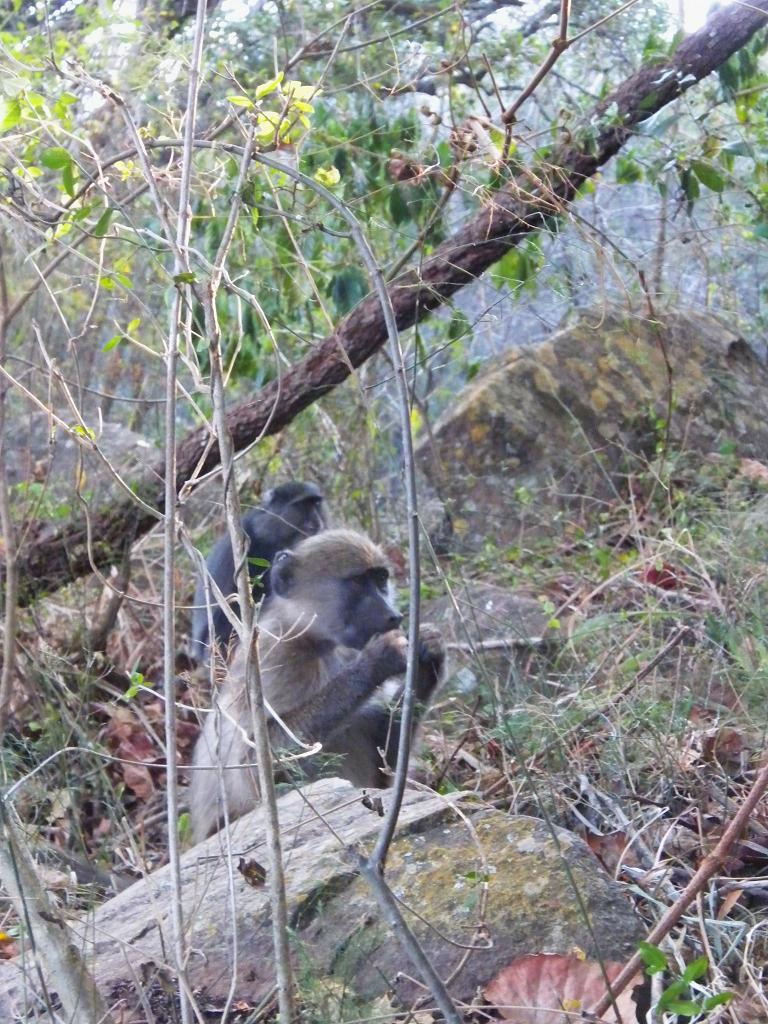
Relatively
often, we are not alone. Some days ago,
when was almost the sleeping time for them, I was following them while they
were approaching the cliffs behind the Barn when the baboons appeared with
their characteristic noises (and smell). I really enjoy watching them; so much
that, sometimes, I’m close to loose my samangos…when is not a baboon juvenile
that hides between my monkeys trying to appear in my scans…but I’m not that
blind…yet. That day, precisely, one of
the baboon males was eating something fluffy and I waited, trying to figure out
what was it. When he finished, he left the leftovers, but a bunch of juveniles
wanted to take a piece; but they ran away when I came closer. I just saw a
fluffy fur without any meat left and some cracked bones. Close, there was a
hole on the rocks covered by blood, so I assume that it was a dassie, but…Then,
I realized that my samangos wasn’t around, so I jumped from rock to rock (my
knees and ankles are really hating me for this) until I saw some…but also to
one of the French students. “This is House troop” I said “No, Barn troop” he
replied “Fuck!” I thought…both troops were pretty much at the same sleeping
site, so , were the baboons!
 Actually,
finding baboons while following the samangos is pretty much a habit, but a
couple of days ago I was pretty excited. I was with one of the scans when I
thought “wait a second, that juvenile is too white” sure it was, it was a
vervet monkey! So there I was, with the vervets at my left and the samangos at
the right and, if it wasn’t enough, a warthog came over, foraging beneath the
vervets.
Actually,
finding baboons while following the samangos is pretty much a habit, but a
couple of days ago I was pretty excited. I was with one of the scans when I
thought “wait a second, that juvenile is too white” sure it was, it was a
vervet monkey! So there I was, with the vervets at my left and the samangos at
the right and, if it wasn’t enough, a warthog came over, foraging beneath the
vervets.
Last days I
have been coming back especially late because we have to record when the
monkeys stop to make noises after getting on the trees. This is how the other
day, close to the Barn, I saw four couples of bright eyes in the dark looking
at me from a tree. The eyes dispersed and a pair came closer; Greater bush
babies! One would thought that they would be scared of the light of the
torches, but they seem to be quite curios about them and this bush baby was
staring at me for a while, before another one joined him.
And these
are some of the things I get in exchange for my isolation. I guess I’ll miss it
when I start to work in the predator side of the project soon, but I think I
won’t miss track of the little samangos, even if I will be following them less
often.

And well…in
a couple of days I will be hitting Kruger...I really hope to see lions!

Subscribe to:
Posts (Atom)